Nursing is at an inflection point. Artificial intelligence is reshaping clinical workflows. Enrollment in nursing programs is climbing. And yet, a stubborn shortage of qualified nurses persists — one that higher wages and expanded pipelines alone have not been able to solve. The profession is changing fast, and the spaces where nurses are trained need to keep pace.
As the industry leans further into technology, another equally urgent challenge is emerging: how do we protect the human side of healthcare? And how can the design of nursing schools help answer that question?
For me and many of my peers, this question is a personal one. Years before I found myself designing for nurses, our family was blindsided by a major trauma. My dad, just 56 years old, was diagnosed with an aggressive stage-4 glioblastoma. The burden on my mom was difficult to bear — by the end, she could barely function herself. The eight months of his illness were riddled with sorrow, but our family found bright spots and glimmers of hope in the nurses that cared for him. Effective, stoic, and full of grace, they were saviors.
Having experienced firsthand the importance of nurses, I believe we, as designers, need to take care of them in whatever way we can. This includes providing learning spaces that will best support them and set them up for success.
Continuing Challenges and Opportunities
On the surface, nursing looks like a field on the rise. Enrollment is up and compensation has improved for many pathways. The professional scope of nursing also continues to expand, with nurse practitioners taking on roles that were once the exclusive domain of physicians.
Creative uses for technology have also shown potential for better patient care. Virtual healthcare is becoming the new norm, rising exponentially during and after the COVID-19 pandemic. Duke University’s robot, TRINA (Tele-Robotic Intelligent Nursing Assistant), has shown genuine promise in supporting patients under quarantine, reducing exposure risk while maintaining a level of connection and monitoring. Artificial intelligence is beginning to take on time-consuming tasks like charting and diagnostic processing, potentially freeing up nurses to focus on patient care.
But enrollment numbers and promising technology only tell part of the story. With the new tech advances have come new challenges. Nurses today navigate a fragmented landscape of interfaces, programs, and documentation requirements. More tasks. More screens. More time at the keyboard and less time at the bedside.
Burnout, technology fatigue, and the weight of an aging population are driving experienced nurses out of the profession faster than new graduates can replace them. The shortage is real, and the forces accelerating it are becoming more complex.
Designing for Burnout Prevention
Burnout in nursing is no longer just a workforce retention problem. It is a public health issue. And while institutions have historically addressed it reactively through employee assistance programs and mental health resources, there is growing recognition that self-care needs to be taught in tandem with patient care, beginning in nursing school.
Many of the students who are now entering nursing programs came of age during the pandemic lockdowns, spending their formative years learning and socializing through screens. They arrived at college with a hunger for community that comes through learning alongside others in a shared place.
The design of nursing schools has a direct role to play in addressing this. Community is one of the most powerful buffers against burnout, and the physical environment either builds community or makes it harder to find. When we think about how spaces are organized — where students gather between classes, how simulation labs open onto collaborative areas, and how faculty offices relate to student commons — we are making decisions that either support or undermine the relational culture that nursing depends on. These decisions are important for reinforcing student belonging, a fundamental piece of student success.
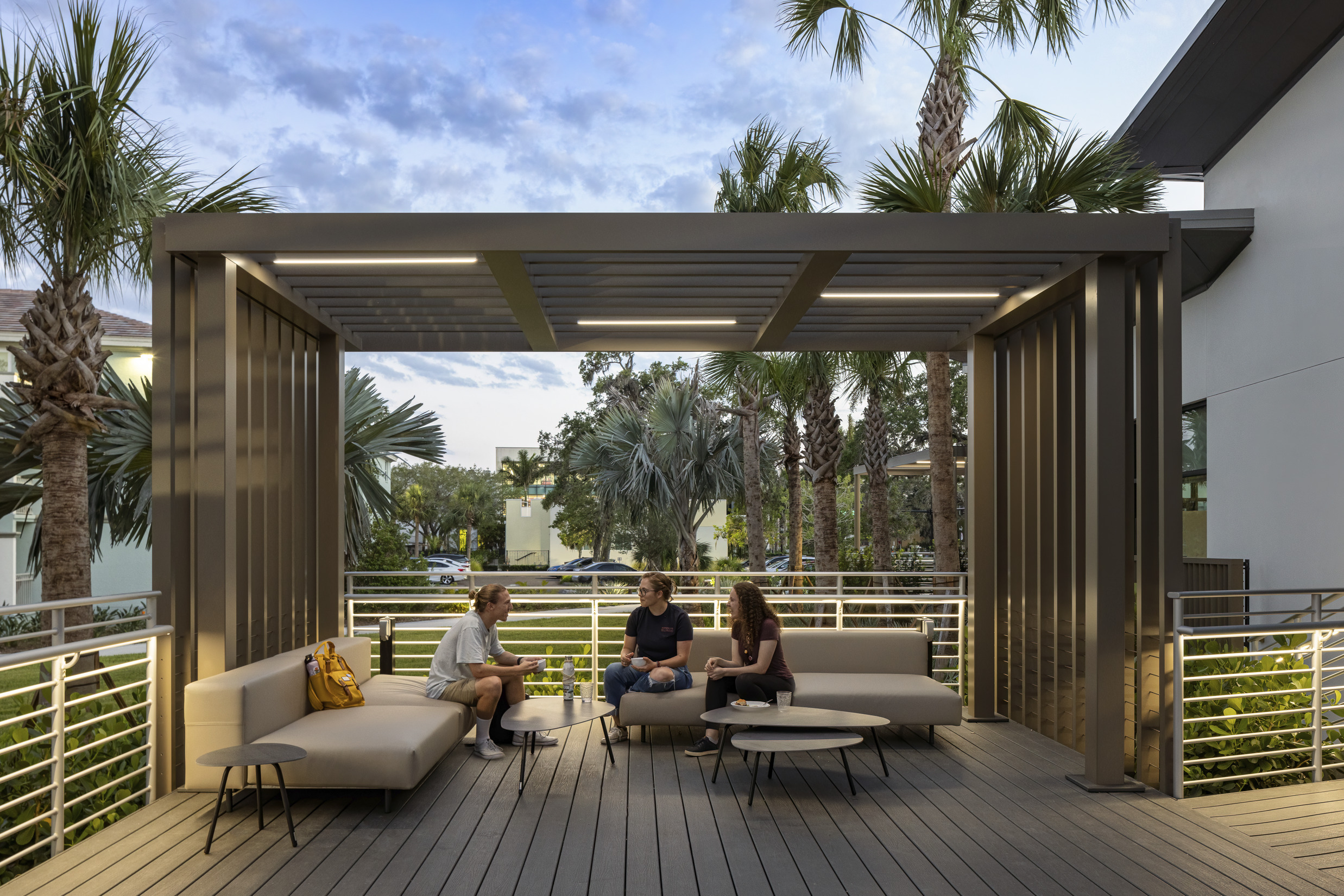
A great example of this can be seen at the Conway School of Nursing at The Catholic University of America. Designed with occupant well-being in mind, the building incorporates numerous communal gathering and study spaces, as well as an honorary reading room that promotes learning, fellowship, and reflection. A roof terrace with lush greenery and exterior courtyard encourage students to step away and embrace the inherent human need for the natural world.
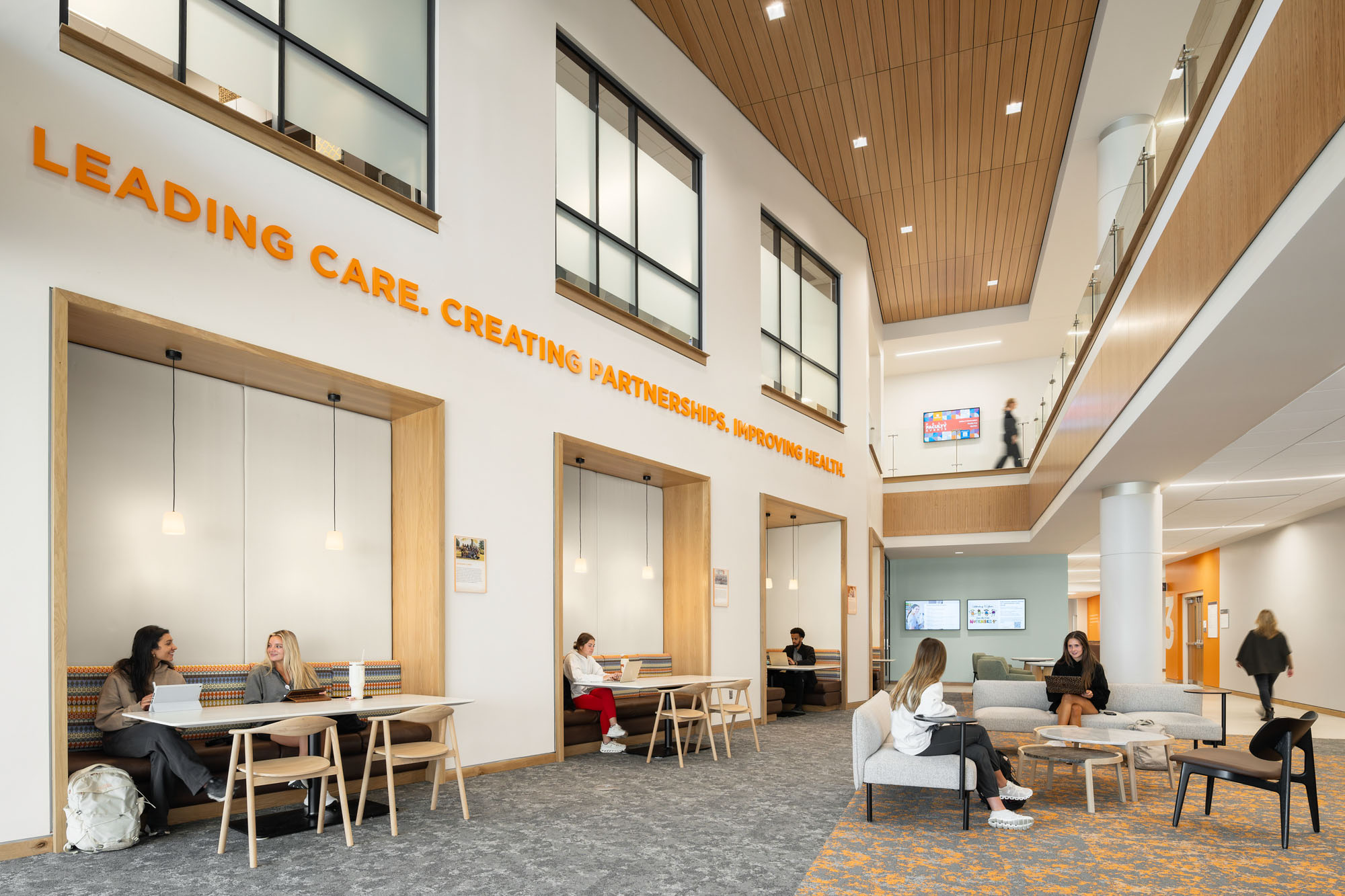
The UT Medical Nursing Building at the University of Tennessee, Knoxville, has similar design goals and features numerous informal gathering areas where students can quietly study or build community. A private student commons on the third floor features wide-ranging views of campus, as well as soft seating and upholstered niches where students can take a break and unwind after intense training exercises.
“If I had to point to one space in the new building that truly captures our vision for student life, it would be the third-floor student lounge,” says Susan Hébert, assistant dean of simulation at the University of Tennessee, Knoxville College of Nursing. “You can watch students find their own rhythm there, some tucked into a booth, some gathered around a whiteboard, others stretched out on a couch between classes. It’s quiet enough to focus, flexible enough to collaborate, and comfortable enough to sit with a meal and just breathe. Every time I walk through it, I’m reminded of why this building and especially this space matters.”
Time to decompress, space to reflect, and access to elements of the natural environments, like natural light, are not amenities. They are instead critical infrastructure for molding a sustainable nurse workforce.
Rethinking the Classroom
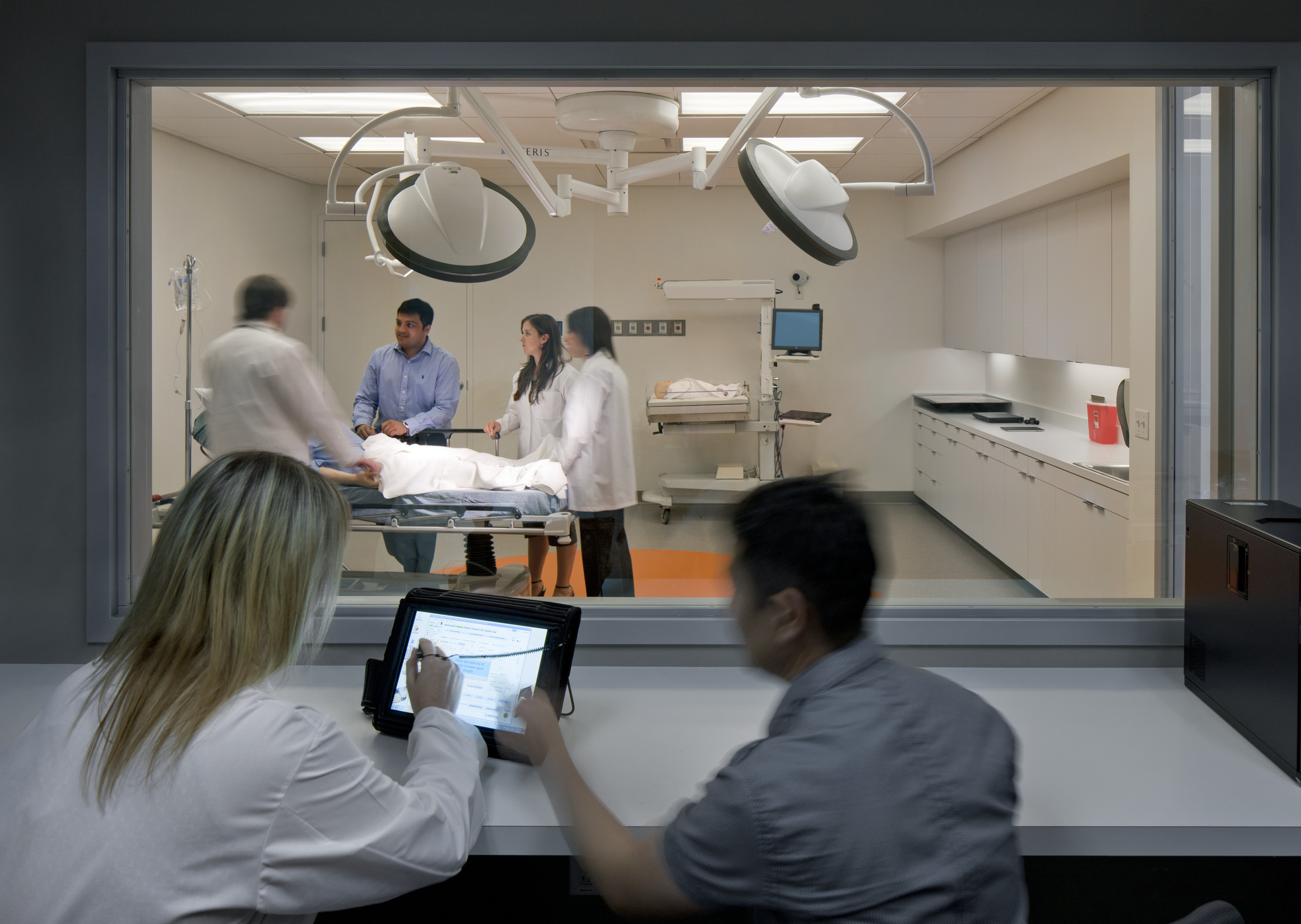
There is no question that technology is transforming nursing education for the better. Immersive simulation environments can now replicate extraordinarily detailed and high-stakes medical scenarios, giving students hands-on experience that would have been impossible to recreate in a classroom a decade ago.
The balance between lecture-based and hands-on learning has been shifting for years, but the pace is accelerating. Simulation labs, skills practice areas, and collaborative learning environments are now, for good reason, claiming a larger share of the program footprint. Nursing is a practice discipline. Students learn by doing, and the spaces that support active learning need to reflect that.
At the same time, the rise of home-based and telemedicine care is creating new questions about how nursing education should prepare students. If a growing share of patient interactions will happen remotely, how do nurses learn to establish trust, read nonverbal cues, and deliver compassionate care through a screen? The environments where students practice these skills must be flexible to changing conditions. Without the senses of touch and smell, spaces should encourage shifting pedagogies to enhance visual and audible context clues.
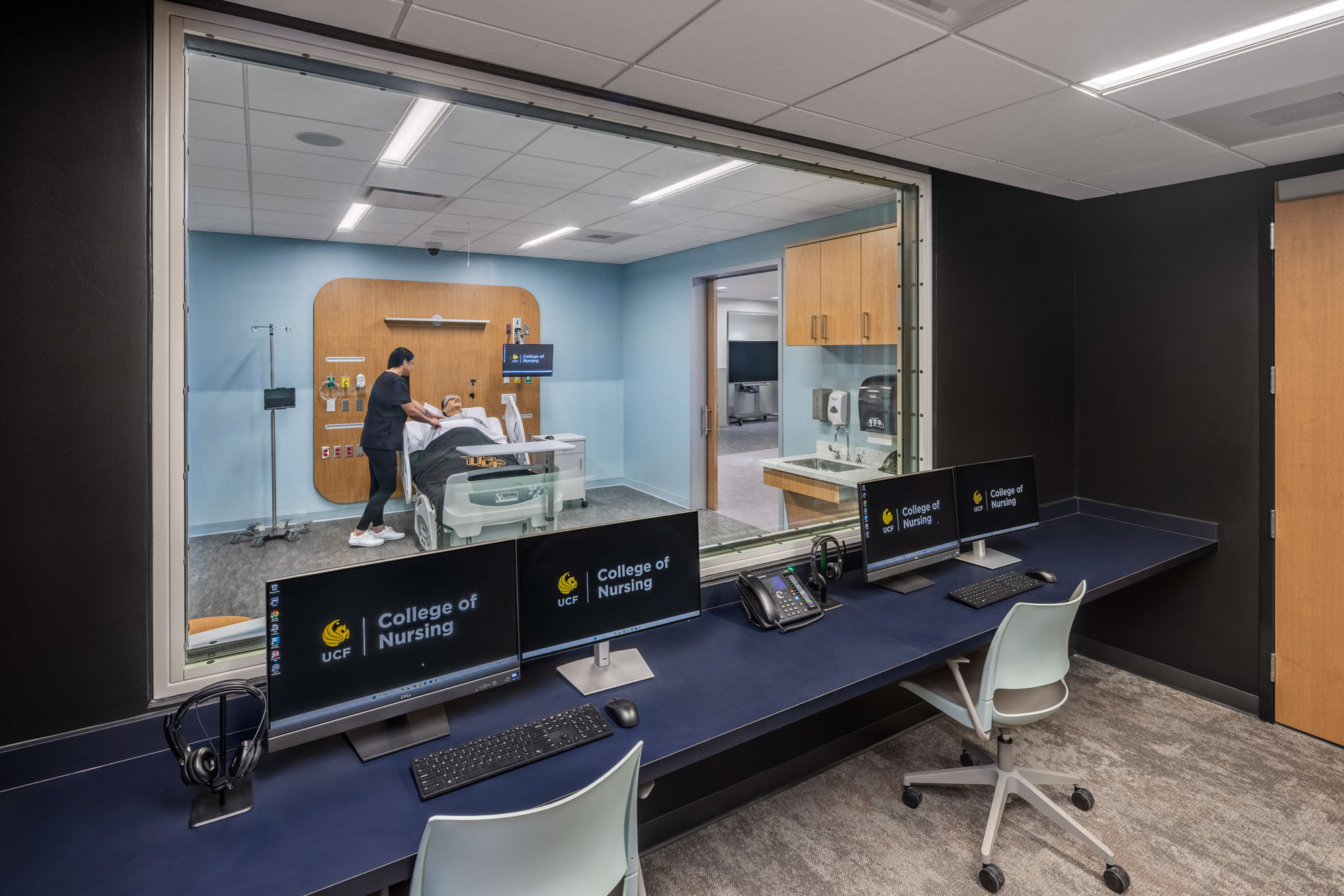
The Dr. Phillips Nursing Pavilion at the University of Central Florida is designed to integrate and embrace these new technologies and challenges, with a simulation center that spans two floors. An immersive reality research room allows faculty to pilot and conduct dry runs on simulation scenarios before deploying them to students, while a virtual reality lab for students accommodates all modes of XR for mixed or augmented reality simulations.
The Designer's Role
As architects who specialize in health-focused higher education environments, our work helps shape future generations of healthcare providers. Through every corridor, gathering space, and simulation suite, these buildings communicate what the profession values and what is expected of those who enter it.
The challenge before us is not to choose between technology and humanity. It is to design environments that unify both: spaces that embrace the power of simulation, AI, and digital tools, while never losing sight of the relationships between caregivers and their patients.
That balance won’t happen by accident. It requires intention and design leadership — and it starts with the students, faculty, and clinicians who live and work in these spaces every day. At Ayers Saint Gross, we are committed to listening to their experiences and leading a path forward to more human-centered learning spaces.
Jason Hearn, AIA, LEED AP BD+C, is an associate principal specializing in health sciences and academic buildings.