Ayers Saint Gross has celebrated Earth Day every year since 2012 with Green Week, a series of continuing education and social engagement efforts that helps us share industry trends related to sustainability, individual expertise, and project updates. It also inspires us to advance our work in creating healthier, more resilient, and decarbonized designs.
This year’s Green Week took place April 20-24 and included internal presentations from three of our practice groups; an update on our firm’s performance against its own Sustainability Action Plan, the AIA2030 Commitment, and the AIA Materials Pledge; and the firm favorite Sustainability Snack Plate – a series of nine rapid-fire presentations from employee-owners across the firm.
Monday’s session featured three case studies from our Planning + Strategy practice group. Nicole Ostrander presented on the planning study for Swarthmore College’s McCabe Library that we recently completed. In this study we evaluated the feasibility of achieving a Living Building Challenge Petal Certified project that would align with the institution’s decarbonization targets. Jessica Leonard spoke on our work at the University of Wisconsin-Madison, completed in partnership with Huron Consulting Group, that quantified the environmental and economic impact of maintaining business-as-usual space utilization or reinventing space in-place. Rounding out the session, Sarah Wright shared lessons learned from the University of Missouri’s Campus Master Plan 2024 about strategies for evaluating the renovation and renewal potential of existing facilities.
On Tuesday, our Landscape Architecture practice group came to the fore with Brian Kinninger sharing more about the landscape design for The Ridge, a graduate student housing building at Emory University for which Ayers Saint Gross designed both the landscape and the building. Brian taught us about the working landscapes and hardscapes of the project and how they integrate stormwater management functions. He also described how they preserved trees on site, which helps the project appear well-established and integrated into its context from opening day.
Adam Bridge continued the presentation sharing lessons learned from working on a confidential client’s 100-year master plan and the considerations taken for thinking through sustainable land use planning and development over such a long timeframe, including considerations for how climate change may influence what plants are adapted to the region over time. Allison Wilson closed the session sharing data on two years of landscape projects and how they measure up to the firm’s Sustainability Action Plan.
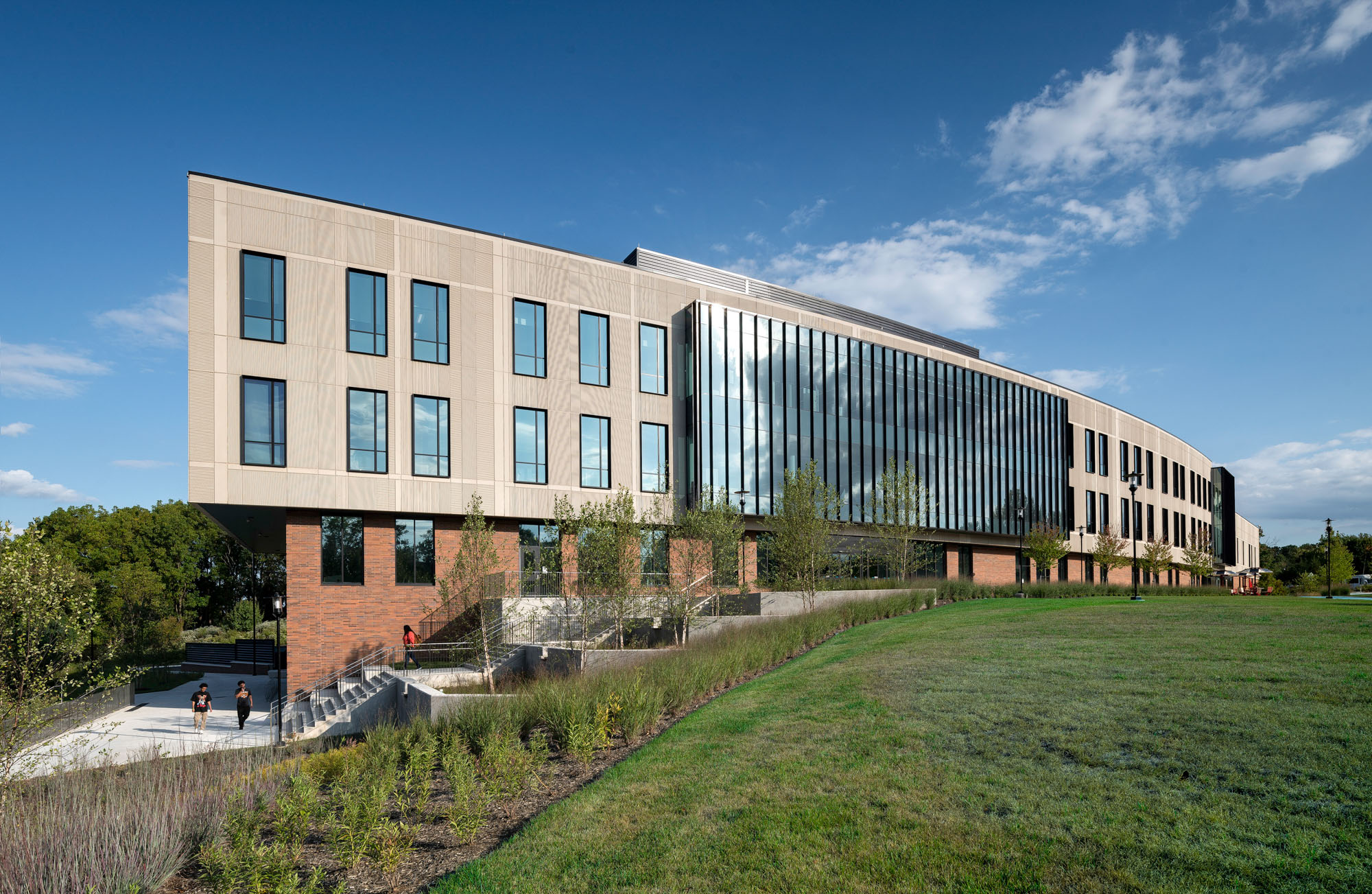
Wednesday featured our Architecture + Interiors practice group. Greg Overkamp shared lessons learned from the recently completed Kahlert Foundation Complex including evolutions in bird-safe building design and how the projected exceed the State of Maryland’s requirements by earning LEED Gold.
Zoey Spangler and Phillip Raguindin shared stories from Emory Oxford College where the new housing complex’s courtyard space was shaped through design analysis to be optimized for environmental conditions. And last but not least, Rainey Hufstetler taught us about the Dragun Building Renovation and Addition at Anne Arundel Community College and how the project creates a new campus heart and a welcoming space for students, faculty, and staff through the reinvention of an existing building.
We also reflected on the extent to which we’re meeting our firm’s stated Sustainability Action Plan goals as well as the AIA2030 Commitment and the AIA Materials Pledge. Focusing on the AIA Materials Pledge first, in 2025 our reporting include 100% of our eligible projects which totaled 41 projects across interiors and whole building / renovation projects. By the numbers:
- 98% of the interiors square footage we designed in 2025 met the AIA2030’s lighting power density reduction target.
- Our whole building and major renovation projects are predicted to reduce their energy use intensity 46% from baseline. This is significantly below the program’s target, but over 15 years of reporting our data overall is trending in the proper direction.
- 36% of the whole building and major renovation square footage we had under design in 2025 included no on-site combustion, up from 27% in 2024.
- 37% of the project we reported in 2025 have been or will have embodied carbon modeling.
- 75% of the projects we reported in 2025 have been or will be energy modeled.
Transitioning to our performance on the AIA Materials Pledge, I’m proud to share we completed all required reporting for both the 2024 and 2025 reporting years as well as the beta test. In reporting years 2024 and 2025, we also shared data on 100% of our eligible projects and for RY2024, Ayers Saint Gross projects made up 6% of the industry’s project-scale data set reflected in the American Institute of Architects’ October 2024 publication AIA Materials Pledge By the Numbers.
Reporting on the Materials Pledge has taught us a lot about our firm’s practices for material specifications and highlighted meaningful and cost-effective ways we can elevate our specifications. We’ve increased the internal training we provide on sustainable materials and our knowledge base is increasing, particularly in areas like Social Health & Equity where we previously had very little expertise. Our new thought leadership piece, “Tracing Equity in Material Supply Chains,” shows how far we’ve come as well as how we continue to learn.
Green Week concluded on Friday with the “Sustainability Snack Plate,” a collection of five-minute sustainability presentations by employee-owners throughout the firm. Each speaker presented a topic of their choosing, reflecting a broad range of sustainability topics:
- Lonna Babu spoke about the Design for Freedom Summit she recently attended at Grace Farms.
- Dennis Lynch discussed how we use design analytics to describe sustainability attributes during the pursuit process.
- Slade Sheaffer delivered a pun-filled session on Lake Powell and the Glen Canyon Dam.
- Stephen Wright reflected on 50 years of practice and how his understanding of sustainability has evolved over that time.
- Anna Tiburzi presented an inspiring talk on the importance of pollinators and the black swallowtail butterflies she raises and releases each year.
- Blake Bissen shared a case study on a Living Building Challenge project he really appreciates, The Living Village at Yale Divinity School.
- Matt Pearson shared lessons learned from recent mass timber projects including details that elevate the construction and experience.
- Angi Kim shared the riches of her mother’s home garden and how her mother demonstrates her love of all living things.
- Thomas Lagarde and Zoey Spangler closed the session with updates on our new headquarters that is pursuing both LEED and Fitwel certifications.
Green Week 2026 was filled with knowledge-sharing, collaboration, and calls to action. More than half the firm’s employee-owners attended sessions, earning over 200 hours of continuing education over the course of the week. With our 2030 deadline for achieving carbon neutrality only a few years away, we remain committed to advancing our sustainability goals.
If you are interested in working with our team or learning more about how your organization can implement sustainable design, please reach out to our Sustainability Director Allison Wilson.