
The word ‘quantum’ refers to the smallest indivisible unit in which a physical quantity such as light or energy can exist. Quantum mechanics is the branch of physics that studies nature at these small scales. The field of quantum computing, however, is quite vast as it relies on multiple principles of quantum mechanics to solve both theoretical and physical problems simultaneously.
The goals of quantum computing are to solve problems that classical computing systems cannot solve, by using two concepts called superposition and entanglement. Superposition allows a quantum bit (qubit) to be two-states simultaneously. This can be likened to a traditional computer bit acting like a coin lying flat on a table with only one side exposed at a time, where a qubit acts more like a coin spinning on a table and embodying both heads and tails simultaneously. Entanglement allows two qubits to act together as shared information, regardless of distance. When these concepts are combined, they permit quantum computing to process vastly more complex information faster and more efficiently than classical systems.
But what exactly is in a quantum facility? The supporting fields for quantum development are still very new but can generally be grouped into categories of hardware development, networking, material development and optics. Each functional category has specific spatial and environmental criteria necessary to their operation, but the primary take-away is that all quantum facilities are heavily influenced by ‘noise’ or the environmental fluctuations caused by vibration, acoustics, electromagnetic interference (EMI), temperature and humidity changes.
Starting with hardware, qubit development has not coalesced around a singular type. Superconducting qubits are currently the most widely used (Google, IBM) as they are the most compatible with classic chip technology. Superconducting qubits are typically made of aluminum which is cooled to 10-20 millikelvin through use of a dilution refrigerator cooled by a combination of helium-3 and helium-4, located inside of a vacuum to prevent air conduction. Helium stays liquid even at temperatures near absolute zero, which allows continuous cooling to maintain the quantum state. Unfortunately, H-3 is not readily available on Earth, though mining on the moon is expected to begin in future decades. Requirements for superconducting facilities include RF-shield enclosure to provide electromagnetic isolation, ultra-low (VC-E or better) vibration and highly controlled temperature stability.
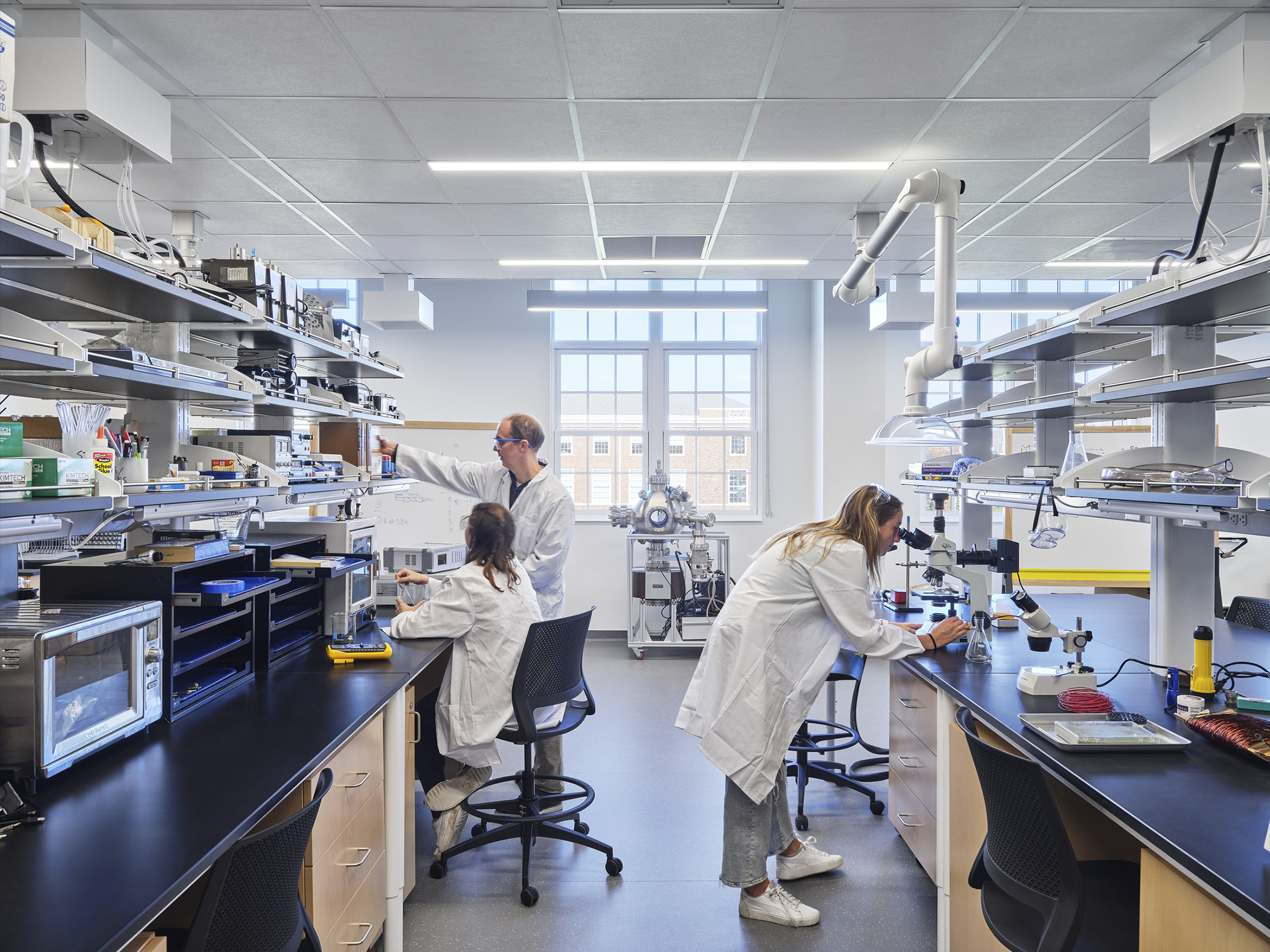
The next most common hardware are trapped-ion qubits (IonQ, Honeywell) which are typically developed in Atomic, Molecular and Optics (AMO) Physics labs. This process traps individual ions in a vacuum using electromagnetic fields and produces very stable qubits, but slower operations. Requirements for AMO labs typically include large optical tables, laser safety infrastructure, beam delivery systems (and 12-15’ high ceilings), cryogenic or ultra-high vacuum trap systems, ultra-low (VC-E or better) vibration, temperature and humidity controls. Due to the materials being produced, dust and vibration must both be mitigated, therefore localized laminar flow hoods may be implemented along with strict cleaning and material handling protocols.
A third hardware type include photonic qubits, where photons are generated with lasers and operated through beam splitters and optical circuits. While also developed in AMO Physics labs, additional requirements for chip-based photonics may include ISO 5 cleanroom with HEPA filtered airflow, particulate mats and gowning protocols. Photonic qubits appear to be most useful for quantum communication as they permit light-speed transmission over long distances, both via fiber optical cable or satellite-ground link connections. Photons can also link different types of qubits (like superconducting or trapped-ion) in a modular quantum computer thereby acting as network nodes. In 2024, Qunnect and NYU demonstrated a quantum‑secure link over a 16 km fiber path connecting Manhattan and Brooklyn, while there are other networks in development along the eastern seaboard (Boston to DC), Chicago, Chattanooga, Indianapolis, Tucson and Berkeley testing a variety of new and existing fiber systems.
Other experimental/emerging types like spin-qubits, NV centers and topological qubits may offer advantages such as better noise resilience, room-temperature operation, or easier scaling in certain directions, but are not yet well-enough developed. All of the identified hardware development typologies are likely to require cleanroom support similar to the photonic qubits for nanofabrication and materials growth. While the amount of cleanroom may vary along with the ISO level, a minimum of ISO 5 should be anticipated. In quantum, cleanroom/fabrication is often the single most expensive and space-intensive component.
Not all quantum networking labs use photonic qubits, although photons are the most common choice because they are ideal for transmitting quantum information over long distances. Most of the testbeds identified above use photonic qubits for entanglement distribution and quantum communications, though some such as NV centers use hybrid solutions to store memory (spin-qubits) and transmit information (photonic). These hybrid quantum network solutions are considered crucial for scalable, commercial use. Networking labs must be thermally stable and electromagnetically quiet, along with providing fiber-optic routing infrastructure, optical benches and similar. These labs are often co-located with AMO labs due to their interconnectivity.
Supporting the environmentally intensive laboratories are additional lab support spaces such as cryogen storage rooms (He, LN2), optics/laser service rooms, electronics and machine shops, coatings/metrology labs, dark rooms and similar specialty support. All lab bays and hallways should be presumed to be vibration-isolated, with superconducting and AMO labs being the most sensitive, followed by photonics. Networking labs are less sensitive to vibration and acoustics, but require additional EM shielding. Additional computational theory and simulation spaces should be included with standard office environments, networking and backup power.