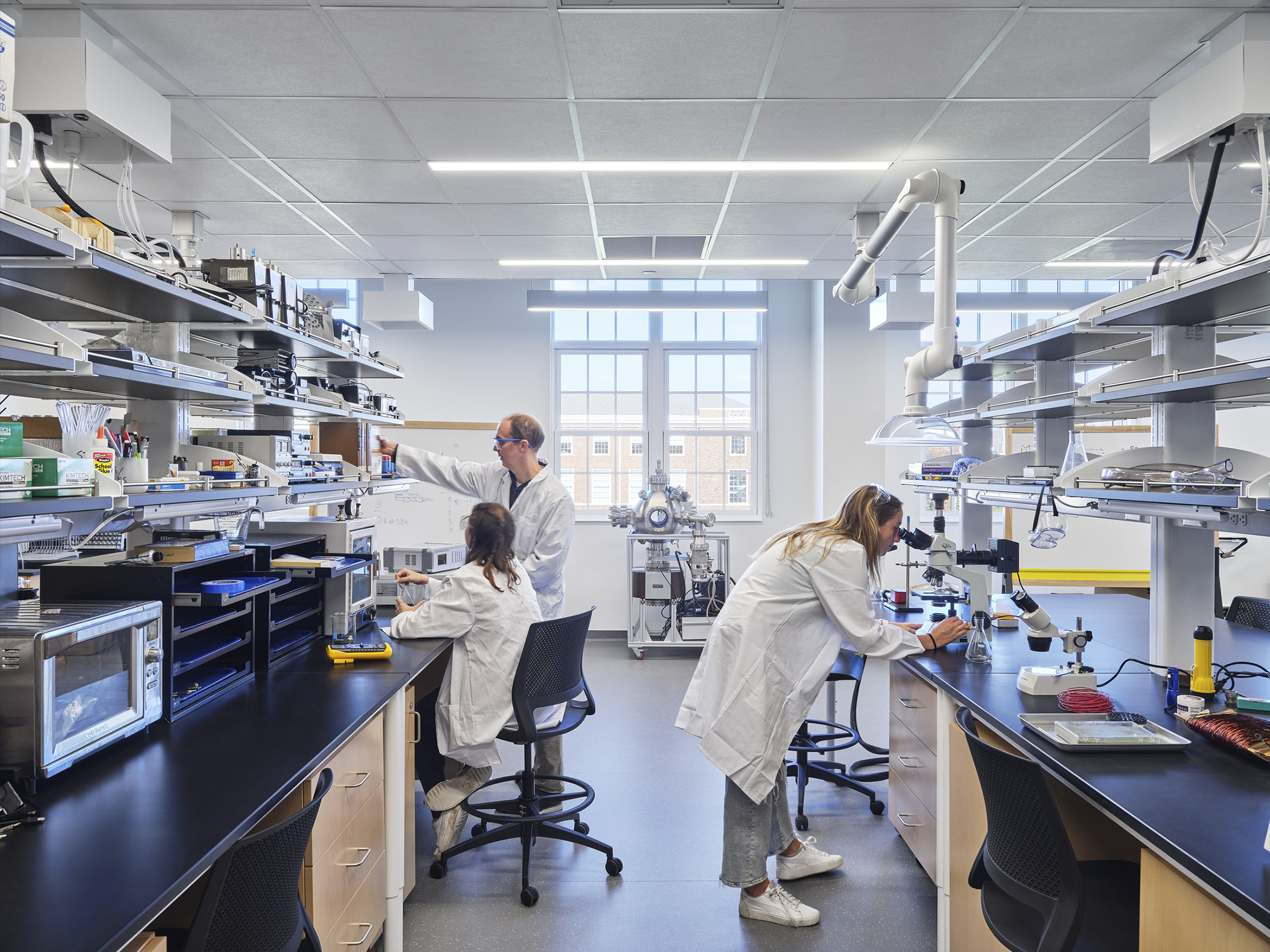
Physics and materials science lead the transition for structural reasons. Physical systems obey known laws; the search space, while large, is bounded and navigable. Instruments like X-ray diffractometers, electron microscopes, and neutron scattering beamlines generate large volumes of structured, high-quality numerical data that AI processes efficiently. Computational methods — density functional theory, molecular dynamics — have reached a fidelity where AI trained on simulation data transfers reliably to physical experiments. And synthesis and characterization workflows are physically compatible with robotic execution: the operations are repeatable, the tolerances manageable, the environment controlled. The result is that fully autonomous closed-loop laboratories like ORNL’s INTERSECT and Berkeley’s A-Lab are already operational and producing peer-reviewed results. This is not a future state. Buildings programmed today for physics or materials science programs should treat continuous operation, data-center power densities, and robotic clearance requirements as baseline program elements, not optional upgrades.
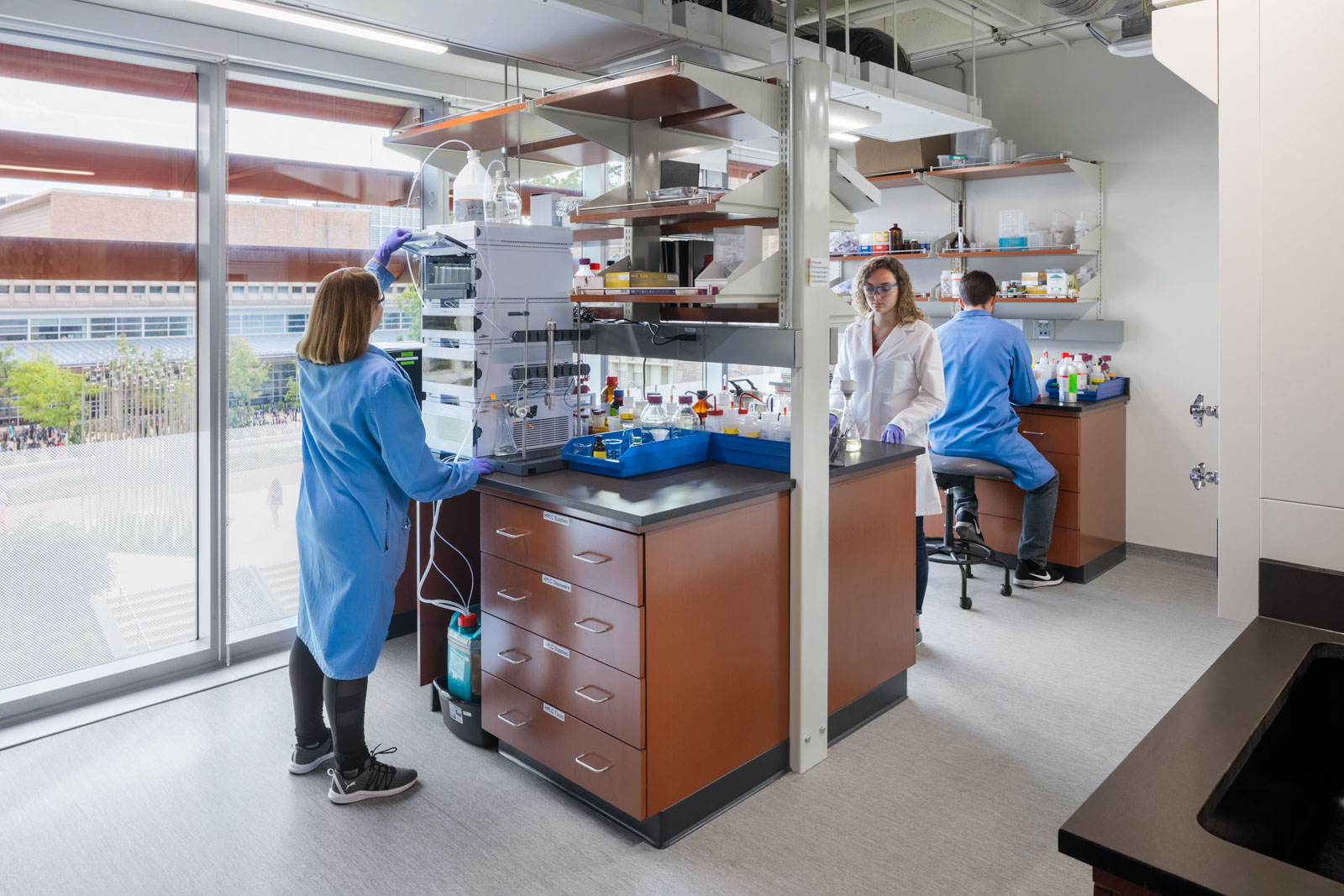
Chemistry occupies a productive middle ground. AI tools now propose multi-step synthesis routes for target molecules in minutes, compressing what was once weeks of literature review. Self-driving chemistry platforms optimize reaction conditions — temperature, solvent, concentration, catalyst — through iterative robotic experimentation. But chemistry is harder to automate than materials science: hazardous reagents, multi-phase systems, sensitivity to trace impurities and handling technique, and the difficulty of scaling AI-optimized conditions from milligram to gram quantities all add complexity. The design implication is significant — autonomous chemistry labs require sophisticated integration of fume hood and ventilation systems with robotic platforms, chemical storage automation, and waste handling. The infrastructure ask is higher, and the programming conversation needs to be correspondingly specific.
Biology presents the most fundamental challenges, but the discipline is not monolithic. Dry biology — computational biology, genomics, proteomics — has been effectively AI-native for years. AlphaFold’s resolution of the protein structure prediction problem was a landmark demonstration; genomics pipelines are now almost entirely AI-augmented; drug target identification via AI mining of genomic and proteomic databases is standard practice. These workflows are compute-intensive but physically simple: they happen in servers, not at benches. The programming implication is straightforward — more compute infrastructure, less wet bench — and it represents a significant departure from historical space programs for biology buildings.
Wet biology is a different story. Living systems are inherently variable in ways that materials science is not: cell lines drift, animal models vary, tissue samples are heterogeneous. That variability is not noise to be filtered — it is often scientifically meaningful, and AI systems trained on one batch of reagents may not generalize to the next. Contamination risk constrains robotic systems in ways that materials science workflows are not. Many biological experiments unfold over days or weeks, foreclosing the fast iteration cycles that make AI so powerful in other disciplines. And regulatory frameworks — IBC, IACUC, BSL classifications — build human oversight requirements into the structure of biological research in ways that limit how much autonomy can be granted to automated systems. The programming implication is not that wet biology buildings don’t need AI readiness assessment — they do — but that the assessment needs to distinguish carefully between dry and wet workflows, and design accordingly.